

Welcome to our deep dive into 32-bit float audio recording, a technology that promises to banish clipping nightmares and preserve extreme dynamics in almost any recording scenario. Whether you’re just starting out or you’ve been in the audio world for years, understanding why 32-bit float is considered revolutionary can help you make better decisions when capturing sound.
In this guide, we’ll cover essential concepts, compare it to 16-bit and 24-bit recording, discuss headroom and dynamic range, explore real-world applications, and clarify when and how to use this format effectively. Let’s begin by revisiting the basics of bit depth, then move on to the unique advantages that 32-bit float can bring to the table.
Table of Contents
Revisiting Bit Depth Basics
Digital audio revolves around the concept of bit depth, which determines how many discrete steps of loudness each sample of audio can represent. The more bits per sample, the finer the resolution of the recorded sound. Before diving into 32-bit float, let’s briefly review how 16-bit and 24-bit formats work.
Bit Depth and Dynamic Range
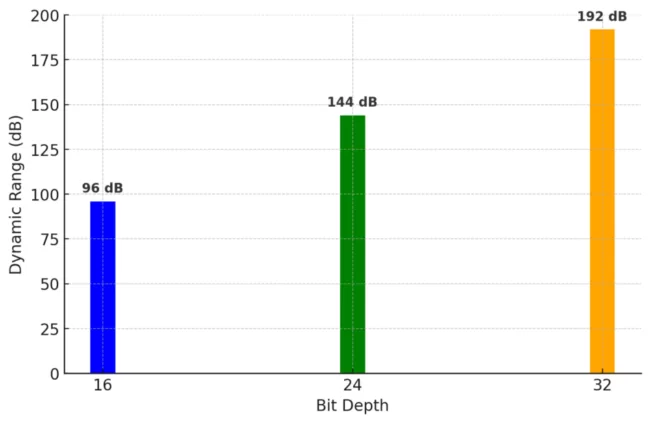
Figure 1: A bar chart showing the dynamic range at different bit depths. Three common bit depths are represented. (Image source: MasteringBox)
Any audio system has to capture sound pressure levels ranging from extremely quiet to extremely loud. In 16-bit recording, there are about 65,536 possible amplitude values, giving a dynamic range of around 96 dB. In 24-bit recording, there are roughly 16.7 million values, pushing the dynamic range to around 144 dB. While 24-bit already provides ample resolution for professional music production, it still has a hard ceiling at 0 dBFS (decibels full scale)—audio that exceeds this limit clips and distorts.
The Problem With Clipping
When the peaks of an audio waveform surpass the maximum level a format can represent, those peaks get “chopped off.” This digital clipping introduces harsh distortion that can ruin an otherwise great recording. In fixed-point formats like 16-bit or 24-bit, once a signal has clipped, the lost information cannot be recovered. This frustration often leads sound engineers to obsessively manage input gain, making sure loud sounds never exceed 0 dBFS. But it’s a constant balancing act: too low, and you risk high noise in quieter passages; too high, and a sudden transient will clip.

Figure 2: An example of audio clipping shown in REAPER. (Image source: Author)
32-Bit Float Basics
Now we arrive at the key innovation. 32-bit float changes the game by storing audio samples in a floating-point format, similar to scientific notation. Let’s talk about what floating-point representation means, and why it gives us what some call “unlimited headroom.”
Floating-Point vs. Fixed-Point
In fixed-point systems, numbers are represented as integers with a hard boundary at 0 dBFS. A floating-point format, on the other hand, splits the stored value into a mantissa (which represents precision) and an exponent (which effectively moves the decimal point around). This approach allows audio data to exceed the traditional 0 dBFS limit without incurring digital clipping in the stored file.
Since 32-bit float allocates 1 bit for the sign, 8 bits for the exponent, and 23 bits for the mantissa, it can represent audio amplitudes far above and below what fixed-point formats can handle. The theoretical dynamic range is enormous—far beyond any real-world audio scenario. More practically, you can record audio that goes well above 0 dBFS and later reduce its gain in post-production, revealing a perfectly unclipped waveform.

Figure 3: 32-bit recording settings in Logic Pro. (Image source: MasteringBox)

Figure 4: 32-bit recording file support in REAPER. Note: You also need to confirm that your audio interface supports the 32-bit float format and configure it accordingly. (Image source: Author)
Unlimited Headroom Explained
By “unlimited headroom,” we don’t mean that no physical component can ever clip. The microphone capsule or the analog preamp might still saturate if the signal is unbelievably loud. But within reasonable operating conditions, 32-bit float ensures that any digital clipping is virtually impossible. Even if the waveform appears to be clipping on a meter, it can often be dialed back down in your editing software without any distortion whatsoever.
The upshot is that with 32-bit float, you worry far less about precise gain settings during the recording session. Whether a sound is faint or thunderous, the file can capture all of it—then in post-production, you can bring up the quiet bits or attenuate the hot signals without paying a penalty in noise or distortion.
Key Advantages of 32-Bit Float
To appreciate why 32-bit float is increasingly popular, let’s focus on its core benefits: effortless capturing of extreme dynamics, freedom from constant gain adjustments, and improved post-production flexibility.
Freedom from Gain Anxiety
One of the biggest advantages is the ability to record in challenging environments without agonizing over gain levels. If you’re alone filming a live event, you might not have the luxury of adjusting your preamps on the fly. With 32-bit float, you can focus on the performance or the moment, fully confident that your audio won’t clip.
Exceptional Handling of Transients
Transient-rich sounds like gunshots, drums, or other sudden spikes can exceed the expected range of a standard 24-bit recording. In 32-bit float, if your analog circuitry can handle it, those transients will be fully captured above 0 dBFS. You simply pull them down in your DAW afterwards to reveal clean, pristine waveforms.
Improved Low-Level Detail
At the other end of the volume spectrum, 32-bit float can also represent extremely quiet sounds with great precision. This matters particularly in field recording scenarios where the environment can shift from a whisper to a roar. The high precision means you won’t boost massive amounts of quantization noise when you later raise the volume of faint signals in post.

Figure 5: Field recording scenarios—such as at the beach—are especially well-suited to the 32-bit float format for capturing sudden transients. (Image source: MasteringBox)
Safety Net for Unpredictable Environments
Nature recording, documentary shoots, and live concerts are rife with sudden shifts in volume. A single piece might transition from near silence to an explosive crescendo. 32-bit float offers a massive safety net, capturing both hush and roar without requiring the user to ride the gain or risk clipping at any moment.
How Dual ADC Designs Help
Many modern 32-bit float recorders implement a dual-ADC approach. This is worth understanding because it explains how hardware itself can capture such a wide dynamic range. Essentially, the recorder splits the incoming signal into two parallel analog-to-digital converters—one set to a higher gain for softer sounds, and another set to a lower gain for louder passages. The device then merges these two data streams into one 32-bit float file.
Merging High-Gain and Low-Gain Streams
Think of it like having two “windows” of volume: a high-gain window that cleanly captures quiet signals but might clip when things get loud, and a low-gain window that handles bigger signals but might be too noisy for very soft passages. Merging the two ensures that the final 32-bit float file contains accurate representations of both low-level and high-level audio, significantly extending the recorder’s effective dynamic range.
Post-Production Magic
When you load such a recording into your editing software, certain sections may appear visually clipped if they surpass 0 dBFS on the software’s meter scale. However, you can simply reduce the gain on those sections and watch the true waveform reappear—pristine and completely free from digital distortion. It feels almost like time travel: the peaks that looked chopped off are actually fully intact.
When 32-Bit Float Shines
Although 32-bit float offers many advantages, there are particular scenarios where it truly excels: unpredictable or wide-ranging sound environments, situations where you have only one chance to capture audio, and certain technical or creative use cases.
Field Recording
Field recordists often deal with massive variations in volume—distant birdsong one moment and a sudden thunderclap the next. With 32-bit float, a single recording can comfortably contain these extremes without clipping at the top or being swallowed by noise at the bottom. Recordists can set up their gear, press record, and focus entirely on the environment rather than constantly adjusting levels.
Live Events
In live sound scenarios—concerts, conferences, weddings—you may not get a second take. Loud applause, spontaneous screams, or unexpected microphone feedback can ruin a 24-bit track if the levels are set poorly. A 32-bit float recording preserves every detail. In post, you can correct any overdriven moments simply by pulling the level down to a safe amplitude.
Studio Sessions
In controlled studio settings, you can usually manage gain meticulously. Still, 32-bit float can be a lifesaver if an artist suddenly belts out a far stronger note or a drummer hits harder than anticipated. Even if an engineer forgets to adjust the preamp in time, the 32-bit float file will retain all the dynamics without distortion—eliminating the heartbreak of discarding an otherwise perfect performance.
Sound Design
Designing sound effects for film, games, or other media often involves capturing explosive or intensely dynamic material. Having a file that won’t clip even with extreme peaks allows for more flexible manipulation later. You can shape and layer sounds freely, knowing you have unblemished transients and fine low-level detail to work with.
Technical Nuances and Myths
With so many marketing claims floating around, it’s easy to misinterpret what 32-bit float can and cannot do. Let’s address common myths and clarify the real limitations.
“32-Bit Float Has More Detail Than 24-Bit”
While 32-bit float boasts a massive dynamic range, its precision at a given level is comparable to a 24-bit recording. The real advantage is that you can move that 24-bit “window” of precision up or down an enormous scale. In typical use, you’re not magically getting higher resolution than 24-bit at a fixed volume level; you’re simply ensuring you capture both the extremely loud and extremely soft segments in one pass.
You Can Still Overload the Mic
If the microphone or preamp itself distorts before the conversion stage, 32-bit float won’t rescue that. Extremely loud sources can overload a mic capsule or push the analog circuitry into saturation. The floating-point format prevents digital clipping, but it cannot fix analog distortion that occurs upstream.
Bigger File Sizes and CPU Load
A 32-bit float audio file is larger than a 24-bit file for the same sample rate and duration. With modern storage being highly affordable, this usually isn’t a deal-breaker. However, for multi-hour recordings it can add up. Most modern hardware handles 32-bit float data without significant issues, though portable recorders may draw slightly more battery power.
Not Everyone Needs It All the Time
While 32-bit float is an incredible safeguard against clipping, if you’re in a controlled environment with stable sound levels, a properly gained 24-bit recording can be just as clean. There is no inherent sound quality boost from 32-bit float when you’re not dealing with unexpected volume extremes. Many professionals still rely on 24-bit in the studio, switching to 32-bit float only when needed.
Converting for Delivery
If you need to hand off your audio to a collaborator or client who doesn’t work with 32-bit float files, you can export your final mix or raw files to 24-bit. Simply ensure you adjust levels appropriately so nothing clips when converting to the fixed-point format. This hands off a properly gain-staged recording that retains all the benefits of a noise-free capture.
Real-World Example: Whisper to Scream
To illustrate the power of 32-bit float, imagine you’re capturing a dramatic vocal performance featuring both whispers and shouts. In a typical 24-bit session, you must choose between favoring the whisper (risking clipping the shout) or preserving the shout (risking burying the whisper in noise). With 32-bit float, you simply press record.
The file stores the whisper’s faint detail at a higher internal “window” and captures the shout well above 0 dBFS. In post-production, you drag the shout’s level down, revealing a perfectly smooth peak, then raise the whisper’s level, uncovering low-level detail without hiss. The result is a performance that sounds perfectly balanced across both extremes—as if you had ridden the fader flawlessly throughout the entire take.
Conclusion
32-bit float audio recording dramatically reduces worries about input gain, clipping, and handling extreme dynamics. By offering a huge dynamic range—particularly useful in unpredictable environments—it ensures that both whispers and deafening sounds are captured without distortion. This format combines dual-ADC hardware strategies with a floating-point digital approach to provide a versatile safety net, especially for field recording and live events.
Nonetheless, 32-bit float isn’t a cure-all. You still need to pay attention to analog preamps, microphone choices, and the specifics of any given recording setting. In controlled studio sessions, a carefully managed 24-bit workflow may be entirely sufficient. But for anyone dealing with wide-ranging dynamics, 32-bit float offers peace of mind and post-production flexibility that is genuinely hard to beat.
Ultimately, the choice boils down to your situation. If your work involves sudden volume shifts or unpredictable conditions, 32-bit float provides invaluable headroom to avoid clipped or buried signals. In more stable contexts, 24-bit remains a solid, time-tested standard. Understanding both approaches ensures you’re ready for any recording challenge—and may usher in a future where worrying about clipping becomes a distant memory.
About the Author: Néstor Rausell
Néstor Rausell is the lead singer of the rock band Néstor Rausell y Los Impostores and a Marketing Specialist at MasteringBOX.


UNCUCO S-01A Straight Type Professional Recording Studio Desk-Music Production
Price range: $1,295.00 through $1,758.00

UNCUCO S-02B Curved Type Recording Studio Desk-19 Inch Rack Workstation
Price range: $1,323.00 through $1,695.00

UNCUCO S-03C Curved Type Studio Desk | Professional Music Production Desk for Audio Console Mixer
Price range: $1,678.00 through $1,887.00